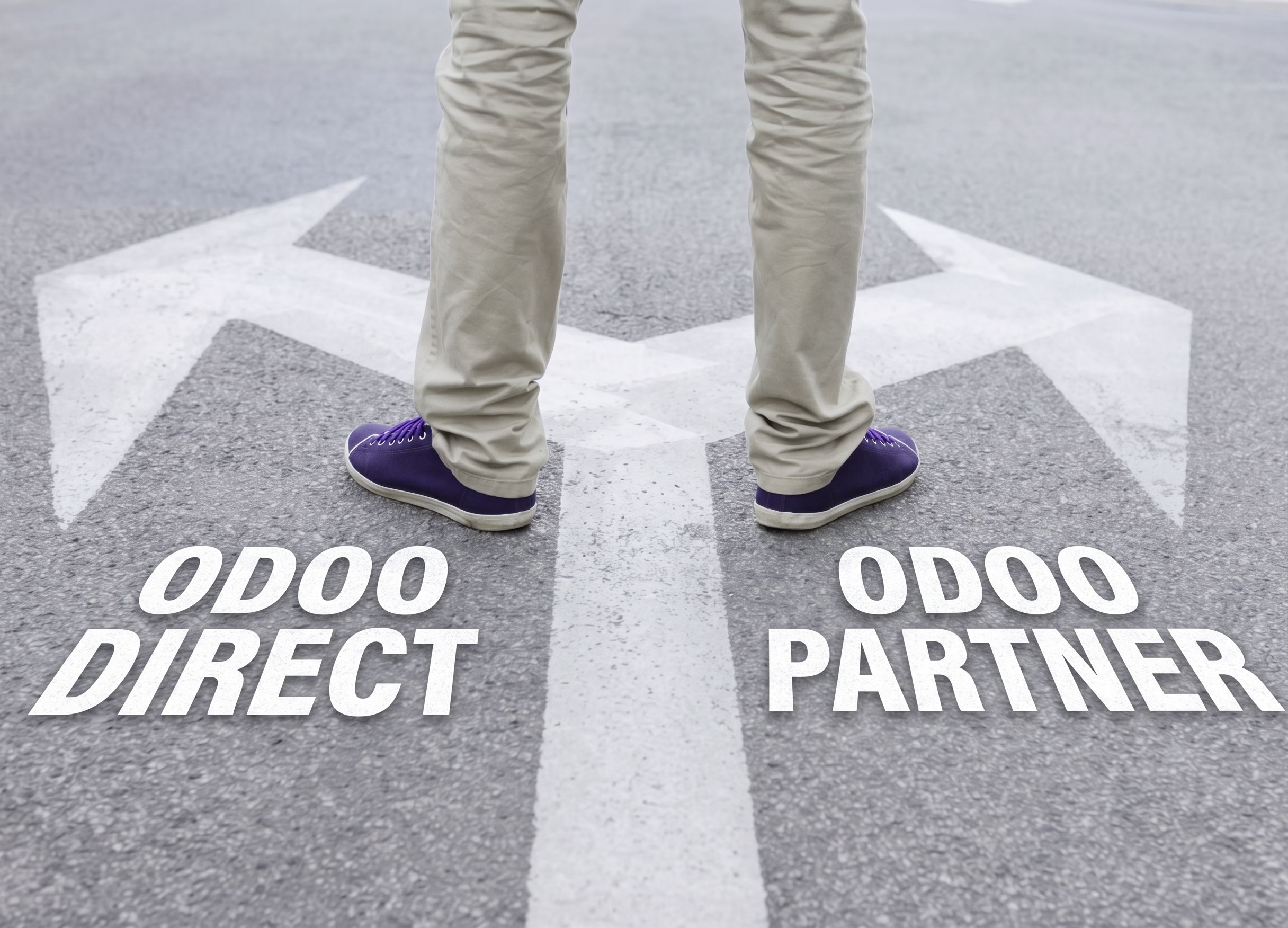
Deciding to use Odoo brings you straight to your next big choice: do you sign up directly with Odoo, or do you hire an implementation partner?
Both approaches can work well. For smaller, relatively standard projects, Odoo Direct is a logical choice. However, as the project becomes more complex, there are some important differences to understand before making the decision.

When Odoo Direct makes sense
Odoo Direct is particularly well suited to implementations that adhere closely to the standard Odoo model.
If your company can implement applications such as CRM, sales, purchases, inventory and accounting without significant customisation or integration with third-party systems, working directly with Odoo could be a good option.
One big plus is that you're working with the company that actually makes the software. The consultants at Odoo use the standard product all the time, and the way they implement it encourages companies to use the standard Odoo processes instead of customizing the system unless they really need to. This approach helps companies avoid unnecessary changes and makes the most of what the software already has to offer.
This might be all you need for a simple setup.
The decision becomes more interesting when the implementation is not so straightforward.
Experience is not just about knowing Odoo
One of the biggest differences between Odoo Direct and an experienced partner is the level and type of experience available for the project.
Odoo has grown enormously over the years and continues to expand its implementation teams. This growth naturally requires the constant recruitment and training of new consultants.
These consultants have direct access to Odoo's methodology, internal knowledge, and product expertise. However, knowing the product and having years of ERP implementation experience are not necessarily the same thing.
An established Odoo partner may have consultants, project managers and developers who have been implementing Odoo for many years and across several versions of the software. Some have seen projects succeed, projects fail, difficult migrations, poorly designed customizations and businesses that initially tried to force their old ERP processes into Odoo.
That experience matters.
A consultant who has encountered the same business problem several times before can often identify the consequences of a decision long before they become apparent to the customer.
The question isn't simply, "Does this person know how Odoo works?"
It should also be, "Has this person seen enough implementations to know what is likely to work for our business?"
Complex projects usually favour a partner
Odoo partners generally become more valuable when a project requires custom development, integration or more complex business processes.
This does not mean that a partner should customise everything.
A good partner should be just as interested in keeping the implementation standard wherever possible. Custom code can incur additional costs for maintenance, testing and migration, and recreating the previous ERP system within Odoo is rarely an effective implementation strategy.
However, sometimes standard Odoo simply isn't enough.
For example, your ERP may need to communicate with an e-commerce platform, EDI network, logistics provider, manufacturing system, external warehouse, payment service or another application that is critical to the business.
At that point, you are no longer just implementing Odoo. You are designing a system in which Odoo is just one component.
A technically capable partner can take responsibility for the wider solution.

Continuity becomes important after the first few months
Another difference that isn't always obvious during the sales process is continuity.
Odoo is a large organisation that manages a very large number of customers and projects. Naturally, consultants move between projects and teams, so the person helping with your implementation today may not necessarily be the person helping you in the future.
Of course, partners can change personnel too.
However, a good partner should retain knowledge at a company level.
There may be a project manager, delivery manager, technical lead or account manager who stays with the customer throughout the process. When someone goes on holiday or leaves the company, responsibility can be transferred without treating the implementation as a completely new project.
Over time, this accumulated knowledge becomes valuable.
Your partner will learn why a particular workflow exists, which areas are sensitive, which integrations are business-critical, and the reasons behind certain decisions made during implementation.
A year after the system goes live, this context can sometimes be more valuable than knowing where a particular setting is located in Odoo.
What happens when Odoo becomes business-critical?
Support is another factor to consider beyond the initial implementation.
With Odoo Direct, problems typically adhere to Odoo's standard support and helpdesk procedures. Given the scale at which Odoo operates, this is understandable.
However, a partner can offer a different type of relationship.
Depending on the partner and the support agreement, you may benefit from defined response times and direct access to individuals familiar with your environment.
Imagine your warehouse is unable to validate deliveries at 9:00 on a Monday morning. Or your e-commerce website stops accepting orders. Or an integration suddenly stops importing hundreds of transactions.
At that point, it's not just a question of whether somebody can solve the problem.
It's also about how quickly you can reach someone who understands what's running, what's changed recently, and where to start looking.
For businesses where Odoo has become operationally critical, maintaining a long-term relationship with a partner can be one of the strongest arguments.
Of course, not every Odoo partner automatically provides this. Response times, escalation procedures and responsibilities should be agreed upon beforehand.

A partner doesn't mean more customization
This is an important misconception that is worth repeating.
Selecting Odoo Direct does not mean 'standard Odoo', whereas selecting a partner means 'customised Odoo'.
A good implementation partner should always start by asking whether standard Odoo can fulfil the requirements.
Sometimes, the right answer is to change the process. Other times, it may be necessary to configure Odoo differently. Sometimes, a small customisation can solve a major operational problem. Occasionally, a completely custom component or integration is necessary.
The value of an experienced partner lies not in their ability to write more code.
It's knowing when not to.
Think about the next five years, not only go-live
Most companies choose an implementation provider with one objective in mind: to get Odoo up and running.
However, going live is really just the beginning of the relationship with an ERP system.
New requirements will emerge. Employees will require support. Processes will change. New companies or warehouses may be added. Integrations will evolve. Odoo will release new versions and, eventually, the database and any custom code will need upgrading.
For a small implementation using almost entirely standard Odoo, it can remain perfectly reasonable to manage this directly with Odoo.
However, for a more complex business, it can become increasingly valuable over time to have a team that already knows the company, its infrastructure, its integrations, and the history behind its implementation.
So, Odoo Direct or an Odoo partner?
If you're looking for a small or relatively straightforward implementation that stays close to the standard Odoo offering, Odoo Direct is definitely worth considering. You benefit from the product vendor's implementation methodology and in-depth knowledge of standard Odoo, without the need for an additional company to be involved.
However, as complexity increases, we believe the balance starts to shift towards an experienced Odoo partner.
Integrations, custom development, unusual business processes, infrastructure requirements and business-critical support all benefit from a team that can look beyond the standard product. For a long-term ERP project, knowledge of the customer's business can be just as important as knowledge of Odoo itself.
However, there is one final point to consider: choosing a partner isn't enough. You need to choose the right one.
Ask how long the people involved have actually been working with Odoo. Ask which versions they have implemented. Ask about projects similar to yours. Find out who will own the project after it goes live. Find out what happens when your normal project manager is unavailable. Find out how they handle urgent problems. If the project is significant, ask to speak with existing customers.
A good Odoo partner will offer more than just an alternative way of purchasing implementation services.
The right partner should be a team that understands both Odoo and your business well enough to integrate them successfully for years to come.
Follow Us on Social Media
Stay connected with ERPGAP and follow us on this journey. You can view updates on LinkedIn and Twitter.