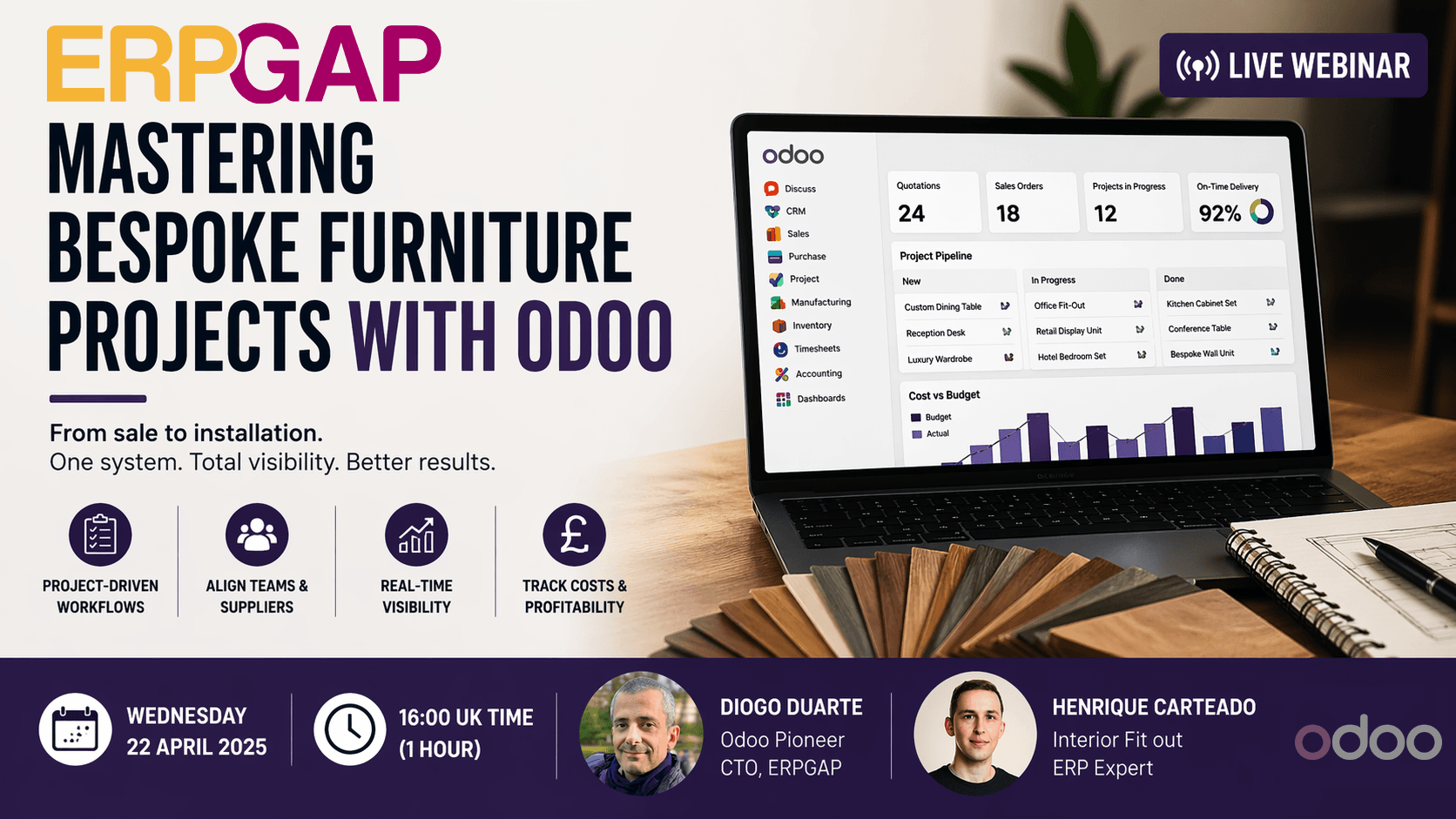
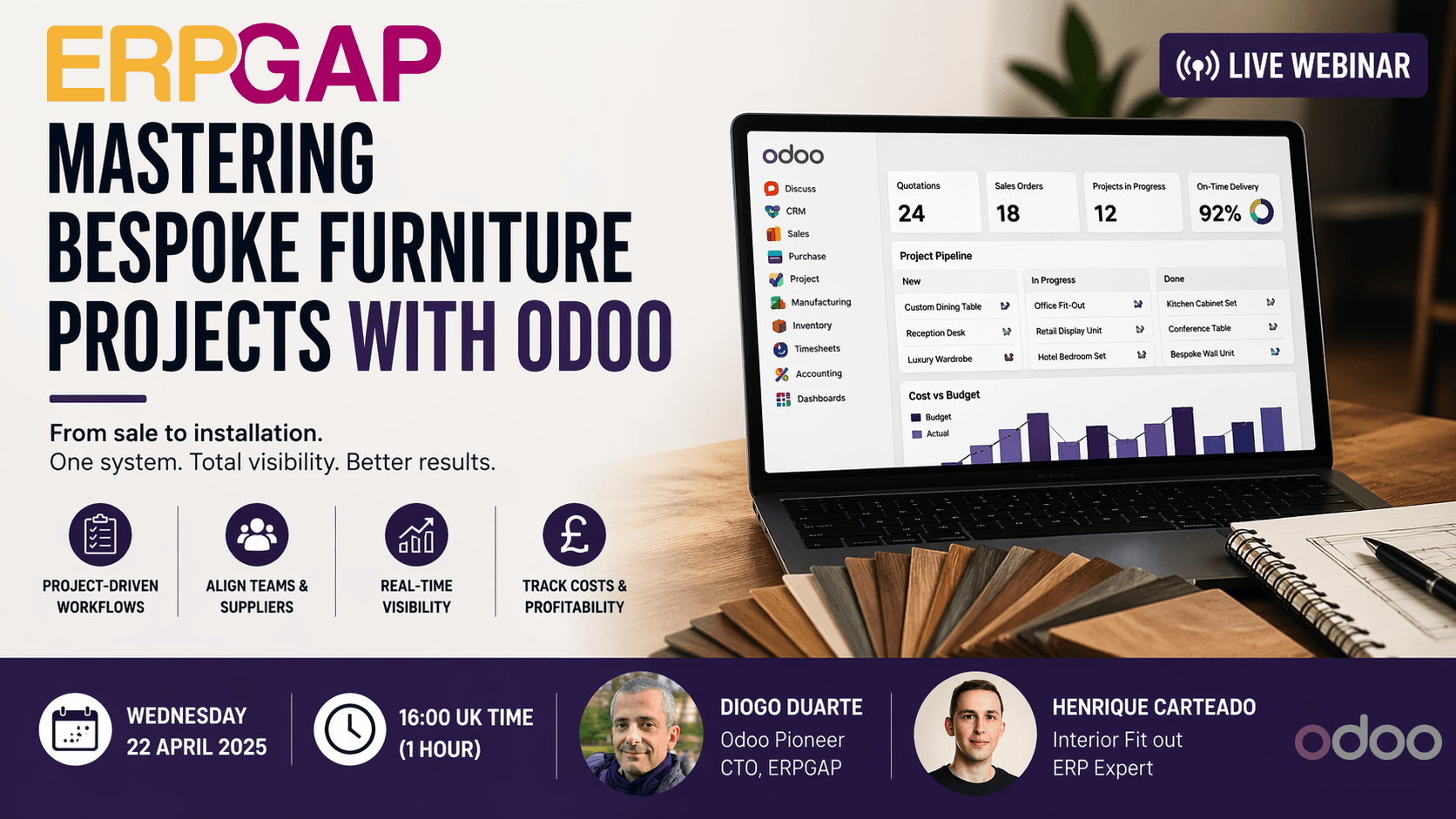
Odoo for Project-Based Manufacturing in the Furniture Industry
Furniture manufacturing is rarely as simple as producing standard products, placing them in stock, and shipping them when a customer orders. That may be how traditional ERP systems are often designed: stock control, repeatable production, standardized bills of materials, and order fulfillment from inventory. But many furniture companies work in a very different reality.
A single order may involve custom dimensions, fabric choices, finishes, drawings, customer approvals, suppliers, subcontractors, internal production, delivery dates, installation teams, and last-minute changes. In other words, the company is not just selling furniture. It's delivering a Project. And when a business is delivering projects, it needs more than inventory management. It needs visibility, coordination, accountability, and a clear connection between sales, operations, purchasing, manufacturing, delivery, and finance.
This is where a project-driven ERP approach becomes essential.
Why Project-Based Manufacturing Is Different
In project-based furniture manufacturing, every sale can feel like its own small business.
A single customer order may involve:
- Custom product configurations
- Multiple suppliers
- Subcontracted operations
- Internal manufacturing
- Site surveys
- Drawing approvals
- Customer material approvals
- Delivery and installation
- Change requests during the project
- Payment milestones
- Ongoing communication between teams
When this is managed through spreadsheets, emails, WhatsApp messages, and people’s memory, things can easily become fragile. A supplier update may stay in someone’s inbox. A drawing approval may be forgotten. A change requested by the customer may not reach production. A project manager may only discover a cost issue when it is already too late.
The problem is usually not that people are careless. It is that the information is scattered.
Odoo helps by bringing sales, projects, purchasing, inventory, manufacturing, subcontracting, rentals, accounting, and communication into one connected system.
Starting from the Sales Order
For many furniture companies, the project begins with the quotation. This is the first moment where expectations are defined: what is being sold, at what price, with which options, under which payment terms, and with which delivery or installation requirements. In Odoo, the sales team can create a quotation with the customer, delivery address, pricelist, payment terms, expiration date, and products. For furniture businesses, these products can include configurable options such as material, size, fabric, finish, color, or other attributes.
This matters because salespeople need to quote quickly, but they also need to quote correctly.
Optional products can also help guide the sales process. For example, when adding a dining table, Odoo can suggest matching dining chairs. This is useful not only for upselling, but also for helping the salesperson avoid forgetting related items that normally belong together.
Quotation templates are especially useful for repeatable project structures. A template might include sections such as:
- Dining area
- Lounge area
- Bedroom Furniture
- Installation service
- Delivery
- Project Kick Start or Site Survey
The salesperson can start from a predefined structure, adjust quantities, remove what is not needed, and prepare a professional quotation faster. Instead of starting from a blank page every time, the team works from a controlled commercial process while still keeping flexibility for each project.
Connecting Sales Orders to Projects
Once the customer confirms the quotation, the real operational work begins. This is often where companies start to lose visibility. Sales has closed the deal, but now the project manager, procurement team, production team, warehouse, accounting, and installers all need to understand what happens next.
In Odoo, a confirmed sales order can automatically create a project and related tasks.
- Assign project manager
- Site survey
- Drawing approval
- Customer approval
- Procurement
- Production
- Balance payment
- Ready to ship
- Installation
- Completed
- On hold
The project becomes the operational home of the order. From there, users can access related sales orders, purchase orders, manufacturing orders, deliveries, receipts, invoices, and costs.
This is important because project managers do not want to chase five different people just to answer basic questions like:
- Has the customer approved the drawing?
- Has the fabric been ordered?
- Has the supplier confirmed the delivery date?
- Is production waiting for materials?
- Has the balance payment been received?
- Is the order ready to ship?
- Are we still within the expected cost?
With Odoo, the goal is to make these answers visible in one place.
Managing Approvals and Internal Communication
Approvals are a major part of project-based furniture work.
A product may need a CAD drawing, a fabric sample, a finish approval, a cut-for-approval, or confirmation from the customer before production can move forward. When approvals are managed informally, delays happen easily. A project may sit still for days because someone is waiting for a response, but nobody else knows that the task is blocked. Odoo’s chatter and activity system helps teams collaborate directly on sales orders, projects, tasks, manufacturing orders, and purchase orders. For example, if a product requires a CAD drawing, an activity can be assigned to a designer with a due date. Once completed, another activity can remind the project manager to send the drawing to the customer for approval. This creates a clearer chain of responsibility. It also reduces the need for people to constantly ask, “Who is handling this?” or “Has this already been done?”
Typical approval workflows may include:
- Drawing for approval
- Cut for approval
- Sample approval
- Fabric approval
- Finish approval
- Customer material approval
- Vendor follow-up
- Manufacturing checks
- Installation confirmation
Some of these workflows can be handled with standard Odoo features. More advanced automation, especially when approvals depend on specific product attributes or variants, may require light customization.
The key is not to automate everything from day one. The key is to make the work visible and prevent important steps from being forgotten.
Procurement and Replenishment
Furniture projects often depend heavily on suppliers.
A delay in fabric, hardware, timber, metalwork, foam, glass, or subcontracted components can delay the entire project. Odoo can support different procurement routes depending on the product.
A product can be:
- Purchased on demand
- Manufactured internally
- Replenished from stock
- Managed with reordering rules
- Subcontracted to an external vendor
For example, if a dining table is configured as replenish-on-order, confirming the sale can automatically generate a request for quotation to the supplier. This helps purchasing teams act faster and reduces the risk of someone forgetting to order a critical item. Odoo’s forecast view also helps users understand current stock, incoming quantities, outgoing demand, and expected availability.
This is especially useful when teams need to answer questions such as:
- Do we already have this material?
- Is there enough stock for this project?
- When is the supplier delivery expected?
- Which sales orders are waiting for this item?
- Can production start, or are we still missing components?
Better procurement visibility means fewer surprises later in the project.
Subcontracting in Furniture Manufacturing
Subcontracting is common in the furniture industry.
A company may produce part of the item internally, send it to a specialist vendor for upholstery or finishing, and then receive it back for final assembly. This can be difficult to track if the company only sees subcontracting as a simple purchase. In reality, subcontracting often involves movement of materials, supplier responsibility, lead times, quality checks, and cost control. Odoo can manage subcontracting flows where the company provides raw materials to a vendor, the vendor performs the subcontracted work, and the finished component is received back into stock.
For example:
- A raw lounge chair frame is purchased or manufactured.
- The frame is sent to an upholstery vendor.
- The vendor upholsters the frame.
- The finished upholstered frame is received back.
- The final lounge chair is assembled internally.
This gives companies better traceability across supplier operations, internal manufacturing, and final delivery. It also helps answer practical questions like:
- Which vendor has the component?
- Which raw materials were sent?
- Has the subcontracted work been received?
- Is the final product ready for assembly?
- What cost has been added by the subcontractor?
For project-based furniture companies, this level of traceability can make a big difference.
Manufacturing, Work Centers, and Quality
Production teams need clear instructions.
They need to know what to make, which materials to use, which operations to perform, what has priority, and what quality standards must be met before the item moves forward. Odoo Manufacturing can manage bills of materials, work orders, operations, work centers, and quality checks. Work centers can include cost per hour, employee-based costing, and planned operations. This allows the company to better understand not only what is being produced, but also how much time and cost are involved.
Quality checks can also be added before completing operations. For furniture companies, quality checks may include:
- Assembly verification
- Upholstery inspection
- Finish quality
- Measurement checks
- Photo confirmation
- Packaging checks
- Quality forms or worksheets
- Final inspection before delivery
This is useful because quality issues are often much cheaper to fix before delivery than after installation. A small defect caught in production may be a simple correction. The same defect discovered on-site, in front of the customer, can become a much bigger problem.
Rentals, Staging, and Interior Design
Some furniture businesses do not only manufacture and sell. They may also rent furniture, provide staging services, or support interior design projects.
These workflows have their own challenges.
A rented item needs to be available for a specific period. It may need to be reserved, delivered, collected, inspected, and made available again. If it is late, damaged, or unavailable, the next project may be affected. Odoo can support rental products with start and end dates, availability, pricing by period, and late return fees. For staging or interior design projects, rental orders can also be connected to the broader project view so teams can track which items are allocated, delivered, returned, or still reserved. This gives companies more control over furniture assets that move between projects, clients, warehouses, and sites. Some visibility improvements may require customization, depending on the business model. But the underlying sales, inventory, project, and rental modules provide a strong foundation.
Preparing for an Odoo Implementation
A successful Odoo implementation is not only about configuring software.
It is also about understanding how the company really works.
Before starting, furniture companies should take time to prepare their processes and data. Useful preparation includes:
- Mapping current processes
- Identifying pain points
- Listing approval stages
- Reviewing quotation structures
- Preparing product data
- Cleaning customer and supplier records
- Removing duplicate contacts
- Reviewing open invoices and bills
- Preparing stock quantities
- Reviewing product costs
- Aligning inventory and accounting balances
This preparation is often where important conversations happen. Teams start to ask questions like:
- Do we quote consistently?
- Are our product names clear?
- Do we know our real costs?
- Which steps create the most delays?
- Which approvals are truly necessary?
- Which spreadsheets are still critical to the business?
- Which manual tasks should be replaced first?
These questions are valuable because ERP implementation is not just a technical project. It is a business improvement project.
For data migration, Excel templates can be used to import contacts, products, vendors, stock, and other records. For larger datasets, scripts can help clean, deduplicate, and transform data before import.
Clean data makes the implementation smoother. Poor data creates confusion, even in a well-configured system.
Keeping Customization Lean
Odoo is flexible, and customization is often possible.
But flexibility should be used carefully. In the early stage of an implementation, the priority should be to go live with a system that supports the core business process reliably. Trying to customize every detail too early can increase cost, delay the project, and create technical debt. A lean implementation focuses first on what is required to operate successfully:
- Can the team quote?
- Can they manage projects?
- Can they purchase materials?
- Can they manufacture or subcontract?
- Can they deliver?
- Can they invoice?
- Can they understand costs?
After go-live, the company can refine workflows, automate more steps, improve dashboards, and add targeted customizations where they create real value.
This approach helps the team adopt the system faster and avoids turning the implementation into an endless customization project.